Categories
Uncategorized

Exploring Heartbreak High (2022): A Discursive Genealogy in Teen Drama

By Yoel Izaguirre

TV seems to be obsessed with trying to get this new generation of viewers hooked on the next BIG TEEN DRAMA!!! As someone who is a connoisseur of TV, I can confidently say that Netflix has hopped onto this trend and has put Heartbreak High (2022) as their submission to the Teen Drama Genre. Heartbreak High is a teen drama series that follows the lives of a diverse group of Australian high school students as they navigate the challenges of adolescence. The show explores themes such as friendship, love, identity, family dynamics, social issues, and personal growth, all the stuff that you would find in a typical teen drama.

Updating Classic Themes

Heartbreak High (2022) is a reboot of the 1990s series of the same name. The show not only revisits classic themes but also actively engages with new cultural discourses, reflecting the evolving landscape of youth culture and the dynamic nature of genre evolution within the media. One notable change from the original series is the significantly increased diversity in the cast of the reboot. The new cast includes representation from Asian, Black, and Blak communities, showcasing a more inclusive and representative portrayal of high school life in today’s society.

The Teen Drama Genre is a popular genre amongst young audiences, I mean the whole reason I even heard about Heartbreak High was because all my friends and TikTok wouldn’t stop talking about it. In this genre, high school settings become the backdrop for vibrant storytelling, where the lives of students and staff intertwine in a whirlwind of drama and excitement. It’s like the writers took a page from a Mad Libs page, weaving crazy yet relatable storylines that mirror the rollercoaster of adolescence. The formula sounds pretty basic. I can think of so many shows that follow this: Degrasssi (a long running Canadian show), Saved by the Bell (a staple in the category), Euphoria (a personal favorite), Riverdale (a personal love/hate), and Sex Education (a British take on teen dramas).

Engaging with New Cultural Discourses

What sets Heartbreak High apart is its fearless engagement with today’s cultural pulse. From social media’s influence and cyberbullying to the complexities of mental health and LGBTQ+ representation, the show dives deep into the experiences shaping modern youth. These themes reflect the concerns and experiences of today’s youth, making the show more relatable and impactful for its audience. One of the main storylines within the show centers on one of the Blak characters being racially profiled and assaulted by a police officer which leads to an examination of the police brutality that Blak folk face within Australia. In essence, Heartbreak High isn’t just entertainment; it’s a mirror reflecting the diverse and evolving landscape of youth culture

Categories
Uncategorized

Burning Bright and Burning Out in the Most Hopeless Place Ever (2011)

By: Theo Weldon

Among the greatest tragedies to befall me in these past weeks was the fact that I did not get the opportunity to share my analysis of the music video for Rihanna’s We Found Love with the class. I’m going to remedy that tragedy now by examining the discursive clusters that surrounded We Found Love in the broader social context of the year it was released (2011).

We Found Love sounds uplift. At a surface level, it could be read as conveying the message that “love triumphs all.” It should be noted, however, that the Rihanna says “we found love in a hopeless place,” she says nothing about love being a positive force and/or a solution to hopelessness. Just the opposite, she says “I’ve got to let it [her feelings] go.” The music video reflects this skeptical view of (hopeless) love, as Rihanna and her lover’s passionate romance descends into a cycle of drug use, explosive arguments, and reckless adrenaline hunting.

With the music video as context, We Found Love takes on a new meaning. Young love is passionate, but it can also be harmful and self-destructive, causing those who partake to lose their grip on reality. The two-toned message is clear… or is it? There is a good bit of extratextual context that is worth considering here. For one, the artist herself, Rihanna, suffered physical and emotional abuse in a highly publicized relationship 2 years prior to the songs release. Morbid as it sounds, the song “rewards” audiences for understanding the extratextual circumstances of the artist. We can take this further. Jason Mittell encourages us to situate genres and texts within prevailing social power structures and to look for “political implications and effects” in “seemingly nonpolitical case studies” (Mittell 19). We Found Love is a pop song, but it is a product of a specific cultural/political sentiment in the late 2000s/early 2010s. We could think of number of pop songs that carry upbeat tunes and darker messages: Outkast’s Hey Ya!, Foster the People’s Pumped up Kicks, Ke$ha’s Die Young. I imagine this historical genre as a product of rising cynicism in the 21st century. 9/11 and the War on Terror ended the honeymoon period the United States had experienced after the Cold War, and the 2008 financial crisis left a generation of youth fearing for their economic futures. Through this framework, we can view Rihanna’s hit single as emerging both personally and societally from a discursive cluster of disillusionment and loss of innocence, one reflected by hundreds of texts, musical or otherwise, produced since the early 2000s.

Categories
Uncategorized

Free Churros? BoJack Horseman Ideologic and Aesthetic Analysis

By Jonathan Nguyen

Let this be clear–I have never seen an episode of BoJack Horseman. Aside from a handful of clips of the show on various social media and excitedness from my friends, my scope of what the show entails is limited to existential audio quotes and adult animation. Thus, having seen BoJack Horseman’s sixth episode of season five, “Free Churro,” on a big screen at the Weitz Cinema at Carleton College, my expectations were exceeded. 

From an aesthetical analysis of “Free Churro,” there is a lot to unpack. The seemingly endless monologue of BoJack giving an eulogy at his mother’s funeral almost feels like I’m drowning in a constant flow of word vomit. This style of narrative story telling in combination with Netflix’s lack of commercials feels like I’m being forced to gulp down everything that’s being feeded to me. Additionally, the aesthetics of BoJack Horseman can also come at odds with its ideological content. Its pure monologue can cause the audience to become bored at times (at least, this was the case for me during my first watch through). 


Furthermore, the lack of major visual changes and the overall minimalistic approach to shot sizes and framing throughout BoJack Horseman’s “Free Churro” guides me to fully interpret the content and words that BoJack is saying. BoJack discusses real-world topics such as coming to terms with the death of a parent (an estranged parent, that is) that transcends the boundaries of the television screen. I honestly found BoJack’s eulogy (or rant?) pretty introspective despite my previous preconceptions of the show (or lack thereof). For just being an adult animation, BoJack Horseman does a pretty good job of bending and twisting and molting together so many different types of genres to create something unique to its brand.

Categories
Uncategorized

The Reality of Reality TV through UnReal

By Florence Basile

Jobs are hard to find in the film industry. Many aspiring filmmakers say they’ll work on any set they can get, even those of reality television. After watching the pilot of UnReal, I’m not so sure. I’ve worked as a production assistant on a few commercial sets and while it is clear that the show exaggerates the poor treatment of production assistants, it is a drama after all, other instances were quite frightening. This made me wonder: is it that simple to categorize a dynamic show like UnReal into the genre of a drama? As Jason Mittell explains in his essay, A Cultural Approach to Television Genre Theory, “linking together these numerous discourses will begin to suggest more large-scale patterns of generic definitions, meanings, and hierarchies, but we should arrive at these macro-features through as analysis of micro-instances” (9). I’d like to take Mittell’s views of television discourse and apply it towards UnReal.

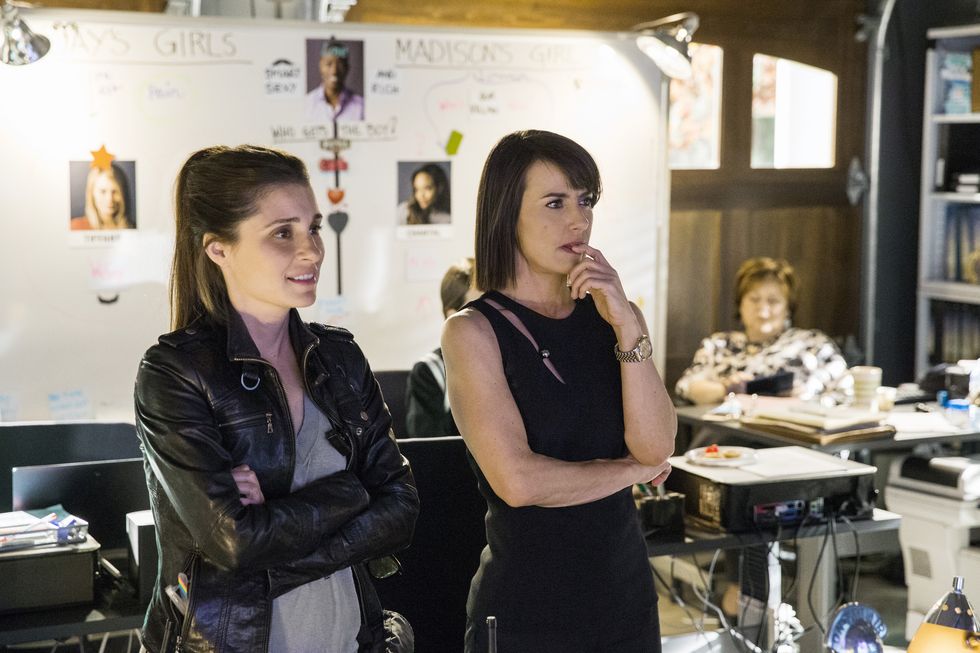
Production discourse was prevalent in this drama, commenting on the making of reality shows like ABC’s Bachelor and Bachelorette (in UnReal, the show was called Everlasting). It’s all a forced reality. At one point, the main character, Rachel, played by Shiri Appleby, blended into the set and used the contestants’ personal information to manipulate them into creating drama. With the help of Rachel, the producer of the show, Quinn, played by Constance Zimmer, strives to please consumers, making characters such as “the villain” and “the MILF” out of the contestants’ actions. Racial discourse was also apparent through the production discourse in the pilot of UnReal, with Quinn claiming that viewers want to see a white woman presented first to the bachelor. Who’s to blame? This is what consumers want, right?

The power dynamics presented in the pilot are another example of production discourse, made clear through the relationship between the creator and producer of the show. The creator, Chet, played by Craig Bierko, is presented as a bit of a slob. While his relationship with the producer of the show is unclear in the first episode, there is a scene where they’re having sex after Chet calls her to his office. It is not loving, with Chet in a dominant position as Quinn is turned away from him. Instantly, I viewed Chet’s character as a representation of powerful men in the industry who use their power to take advantage of women working below them, like Harvey Weinstein. Having watched the pilot nine years after it came out in 2015 and after the MeToo movement began in 2017, according to Mittell I watched the show with a certain historical perspective. As women didn’t start speaking up about Weinstein until two years after the pilot aired, this scene emphasizes how instances like this had been a problem for a longtime. This “micro-instance” was a piece of the “macro-feature” of the show, exposing production discourses in reality television.

The show UnReal exposes the discourses of reality television through a fictional narrative. It’s a drama, commenting on reality television. After watching the show, I’m not quite sure that I’d work as a production assistant on the set of a show like Everlasting – especially if they’d make me pick up trash in disguise as a convicted crew member. But, that’s just me.

Categories
Uncategorized

Identity Politics in “Squid Game” and Why It Was So Popular

In my opinion, few television series have been able to achieve such massive success and popularity like Squid Game. Following Gi-Hun, a divorced middle-aged man who is addicted to sports gambling and struggles with debt, Squid Game centers around everyday characters like us, people who have problems and challenges and are sometimes just too tired of life. At its core, Squid Game is about ordinary people playing ordinary games, participating in a game of death to escape their mundane lives. 

Whether you may have realized it or not, this is actually the most central appeal of Squid Game. Exploring themes surrounding socio-economic status and intersectionality, Squid Game portrays the identities of the people of our society today that are each grappling with their own problems in life. Whether it is Gi-Hun and his debt, Sea-byeok and her attempts to find a new life outside of North Korea, or Abdul Ali grappling with his struggles as an impoverished immigrant worker, the players of Squid Game each come from different walks of life, yet all share one common thing: they don’t want to live like this anymore. There’s nothing special to it, just a relatable desire for a better life. 

Personally, I feel like Squid Game was such an important show to have been produced, especially given the context of Korean society. Being an extremely collectivist society with strong Confucius values and also being one of the most homogenous countries in the world, conversations about marginalized people and struggles are simply not talked about enough. In essence, I think Squid Game was so popular because it depicts ordinary people dealing with ordinary problems. 

Categories
Uncategorized

Reading Evil: Exploring Hall’s Decoding Categories

Paramount Plus’s series Evil follows a trio of truth-seekers—a priest-in-training, a working-class tech wizz, and a Scully-coded psychologist—hired by the Catholic church to work through their backlog of investigation requests into various supernatural phenomena, from demonic possession to medical miracles. I started watching it for a few reasons. First, the first three episodes were available to watch on the plane home for spring break. Second, reading the series description faintly reminded me of an article my mom had sent me about it (she thought it seemed up my alley and she was correct). Third, and perhaps most importantly, I liked the poster advertising the show on the tiny TV screen implanted into the headrest of the seat in front of me. It was hyper-stylized, showing a closeup of a woman’s face turned toward the heavens, impossible things reflected in her tears.

Let me preface the rest of this post by saying I’ve watched a whopping four episodes of the entire show, whose last season airs in May. I’m reading this text based on the arcs I’ve seen develop over the first quarter of the first season. That said, with only four episodes under my belt, I’ve found myself thinking a lot about this show and the way it problematizes questions concerning science and faith.

Startlingly different readings of the series arise through the use of television studies theorist Stuart Hall’s definitions of three broad categories of interpretation, as outlined in his 1980 essay “Encoding/Decoding”: dominant, negotiated, and oppositional. A dominant decoding involves the television viewer ‘correctly’ interpreting the text; that is, deriving the meaning from it that the creators, producers, distributors, etc. encoded into it, whether intentionally or not. An oppositional reading actively resists a ‘clear’ or dominant understanding of the text, instead opting to “retotalize the message within some alternative framework of reference” (173). Finally, the negotiated reading exists between the realms of the dominant and the oppositional, flirting with both lenses and ultimately drawing a more dynamic, ‘complete’ conclusion than either of the other two can on their own.

A few different readings of Evil thus far, per Hall:

Dominant- Many superstitions and “miracles”/religion-based beliefs are rooted in ignorance and stigma around mental illness, as well as structures of power created and sustained to upkeep and emphasize the institution of Catholicism. Many “miraculous”/“unexplainable” things in the world can be explained through close observation and scientific reasoning. Earthly explanations. Science does not, however, explain everything—some things truly cannot be explained through empirical means, or at the very least humankind hasn’t caught up enough to effectively explore these phenomena.

Negotiated- This program is capitalistic in nature but still contains artistic merit and relevant/thoughtful discourse on the human experience and the various ways we make sense of the world around us—through empirical or subjective lenses, or, ideally, both.

Oppositional- Though Evil appears well-intentioned, it, like all television, is simply another cog in the capitalist machine disguised as a legitimate artistic/philosophical effort. It is a part of the same intricate systems of oppression it fictionalizes and seeks to explore. The fact that the three main characters in the series are all employed by the Catholic church exposes their corrupt intentions and morals in this seemingly charitable pursuit of truth and rightness, as well as their creators’ inability to truly challenge this system. Did the individuals involved truly care about debunking harmful religion-based societal assumptions designed to disempower those most affected by systems of oppression, they would refuse to work with the Church and instead strike out on their own as a nonsecular effort to right centuries of lies perpetrated by religions like Catholicism. This program, by having its protagonists employed by the Church, reestablishes the very systems of power it markets itself as challenging. It is nothing more than yet another money-grabbing, formulaic attempt by a dying streaming platform to stay relevant in a world increasingly populated by sensationalist media. True art is not for profit.

In my opinion, this show is an ambitious and complicated effort by makers legitimately interested in problematizing the world around them through the lenses of science and religion, exploring what happens when the two intersect. It is neither patronizing toward religion nor blindly trusting of science. It grapples with modernity through three strikingly different characters of different racial and socioeconomic backgrounds, asking more questions that providing definitive answers.

Categories
Uncategorized

1 MILLION DOLLARS (wait, what is this show about?)

My family rarely watched television together. My parents liked the news, my younger siblings liked Disney Channel, and my older sister liked robotics meetings. However, there was one exception: The Amazing Race. My family and I watched each season religiously for over 5 years, I even had an amazing race themed birthday party in second grade. We were obsessed with thinking about which family members would make the best (or worst) teams and enjoyed fighting about who we should root for. I’m not exactly sure why The Amazing Race became our favorite show but to fund such an expensive show for 36 seasons clearly means my family was not alone. 36 seasons also means The Amazing Race is clearly profitable. 

At around 8:30 pm on April 3, Survivor players voted Mo off the island and credits began to roll. Then, The Amazing Race played and immediately everyone in the Weitz Cinema was bombarded by Expedia ads. It makes sense that the average viewer of Amazing Race would be enticed to travel from watching an episode. However, the bluntness of the programming and flow felt shocking to me. But then I had an epiphany–The Amazing Race is already an ad in itself.

Amazing Race sells a thirst for adventure and idealized view of traveling. Whether it’s eating an insane amount of foreign foods (to the point contestants would often throw up) or yelling at a taxi driver, “FAST, RÁPIDO, MUY RÁPIDO POR FAVOR”, or skydiving, it seems that contestants are being fully immersed in new landscapes and ways of life. The show is yelling at its audience to be free! We should just break out of our comfort zones, leave our jobs, and embark on a tour around the world!

Yet, in reality the contestants don’t seem to be enjoying their once-in-a-lifetime experience. Sometimes they don’t even seem to know what country they’re in. The show, quite ironically, strays away from a romanticized representation of travel by forcing their competitors to focus on superficial tasks, all for the goal of 1 million dollars. Locals are never interviewed during the episode. Oftentimes, they are literal mascots only to be seen at the finish line of each episode.

Looking back, I like to think my family enjoyed The Amazing Race not because of its consumerist themes about traveling and undertones of the exploitation that occurs in the tourism industry, but because of the message of teamwork it offers. Contestants are constantly put into infuriating positions (often traffic) or face a buildup of mental stress that is unleashed upon their partner. Only the teams that can tread the line between supporting one another while adapting on the spot can stay competitive in the race. 

At the end of the day, even with all the problems The Amazing Race has, I still loved watching my favorite childhood show. Decoding the show as a big advertisement doesn’t change the fact that the competition aspect of the show is very entertaining. And who knows, maybe one day I’ll compete on The Amazing Race and follow the footsteps of that one Carleton alumni who won 1 million dollars.

Categories
Uncategorized

XOXO Gossip Girl

I watched Gossip Girl for the first time recently and it momentarily took over my life. I found myself unable to look away and aimlessly searching for some intellectual justification for my interest. As a contemporary viewer, primed by ubiquitous satirical content about rich people behaving badly, I looked for class commentary. What I found was scattered, inconsistent ideology. 

The aesthetics of luxury and excess—showy designer clothes, lavish galas, spontaneous international vacations on private jets etc.—immediately register for me as satire. But while the show is driven by over-exaggeration, it toes the line between satire and aspiration, both mocking and romanticizing ~the scandalous lives of Manhattan’s elite~. Unsurprisingly, soap and scandal power the show rather than a coherent message, which allows for broad appeal across ideological lines and leaves room for various dominant and oppositional readings. It is worth noting that the show premiered months before the Great Recession, which depending on your reading may have made its social critique more scathing or its glamorization of wealth more tone deaf. 

 My own negotiated readings goes as follows. The show is about fascination with celebrity. Gossip Girl, the blog that narrates the show, facilitates this obsession. Whether readers engage earnestly or ironically with the blog and whether they send in tips out of idolization or derision for the Upper East Siders, the proliferation of this content and its solidification of the characters’ icon statuses legitimizes their elite position. As much as these characters decry the exploitative and corruptive nature of the blog, they rely on it to take down their enemies and advance their interests. And outsiders use it as a means of gaining access to an exclusive world. 

My own relationship with Gossip Girl (the show) mirrors the characters’ relationships with Gossip Girl (the blog). Ideologically, I hate the characters and everything they stand for, but my affect keeps me emotionally invested in their lives even as they manipulate and exploit. The show has the potential to interrogate class structure. For example, one character constantly grapples with his outsider status, even as he becomes increasingly insider-y, moving from the slums (read: a spacious Brooklyn loft) to a penthouse in the Upper East Side. The native Upper East Siders understand their inherited wealth as deserved and protect their elite statuses by policing the line between insiders and everyone else. Although the show is rife with material for social commentary, I find myself rooting for the morally bankrupt characters who illustrate the need for critique rather than engaging in the critique myself. 

I can’t help but return to one of my all time favorite shows, Veronica Mars, which coincidentally stars the voice of Gossip Girl, Kristen Bell, as a teenage girl who doubles as a vigilante detective. The 2004 series delivers more precise and effective class commentary than Gossip Girl. It constructs its ideology through its aesthetics and inventive use of genre conventions. Blending film noir and teen drama (e.g. using voiceover narration which is staple of both genres), it creates a prevailing sense of injustice, cynicism, and disorder while granting access to the interior life of a girl navigating her social life, grappling with trauma, and figuring out her identity. As the hard-boiled detective/teenage protagonist, Veronica operates outside and between social worlds, revealing connections between wealth, power, and sexual violence. Unsurprisingly, Gossip Girl aired for six seasons and Veronica Mars was canceled after three due to low ratings.

Categories
Uncategorized

I’m not a Mo/Venus apologist but you gotta blame Survivor a little


I don’t think I like Survivor very much, and I don’t think that’s the show’s fault. Have I only seen one episode? Okay, yeah. Am I coming into this with a pre-existing distaste for reality TV and secret plots that pit people against each other? Kinda, yeah. Depends on the show. I’m not claiming to be the grand judge, jury, and executioner of Survivor, and I don’t believe my personal taste to be important or impactful in any way here, but the context is important here. Cause what unsettled me the most is that I couldn’t distinguish between my dislike towards the show’s premise and their designated hateable characters.

Take Venus, right? She’s one of the names I ended up writing down the most in my notes, along with Mo. They’re both portrayed as people who’re power hungry and “play the game,” which sets up somewhat of an odd, gendered take. Venus brings it up herself and says she doesn’t want to vote out another woman, saying Mo’s not a threat, which makes her somewhat of a shit-stirrer to the already-decided members of her team. 

And then a lot of contestant interviews describe Mo and Venus as dangerous, because they’re manipulative people who’d like power. Mo’s favorite Survivor contestant was someone who burnt bridges left and right, which is something the show makes sure we learn, because it’s juicy gossip and something to read into. And on the one hand, I get it; I’m not a fan of manipulative people, because I’m shit at telling when I’m being manipulated and I like to know where I stand with people. But, on the other hand, I couldn’t stop trying to figure out how much of their interviews were Mo and Venus being manipulative people, and how much of their interviews were the show and the writers editing footage to highlight that facet, to better fit the decisions voted on by the tribes.

It’s not just the editing, either: a lot of the structure of the show is designed to pit people against each other, whether that’s through contests of physical ability or strategy. And, as much as I dislike using this phrase as a dismissal of consequences, Mo and Venus were “playing the game”: using what they considered their strengths to their advantage. I dunno. I ended up in this weird position where I recognized that they’re competing with their own skillsets, in a game that’s engineered to pit people against each other, and yet I still having trouble sympathizing with them, because the number of clips and interviews shown make them really unlikeable. This is not a new idea in television studies: the idea of affect, and what’s real versus manipulating the audience a la The Network.

But it’s worth asking, whose values are being shown here? Those of Venus and Mo, who prioritize their own survival through social manipulation? Or is it the editors and producers of the show, who want to set up an “honest” alternative to Mo and Venus like Ben and Tim—two players who didn’t want to reveal any information about their teams and allies until pressed. The show unsettles me because even though I disliked it and didn’t take it at face value, I still ended up influenced by the show; I still was hoping either Mo or Venus got voted out, and I still thought it strange that Venus had some kind of gender loyalty towards Mo when it goes against the rest of her allies. So, unsettling show, though I only blame Survivor for part of my reaction. It’s one thing to read about how shows are constructed to affect audiences; it’s another to know this and still be affected.

I probably will not be watching the next episode; I still don’t have a lot of interest in reality TV. I may, however, read a recap article or two once the next one comes out because regrettably, Survivor is good at what they do.

Categories
Uncategorized

Veneno: Aesthetics and Ideology

The other day, I was trying to find a show to watch with my friend, and I stumbled upon Veneno, a Spanish biographical drama television series that premiered in 2020. It tells the story of Cristina Ortiz Rodríguez, better known as La Veneno, a transgender icon and television personality who was really big in the 90s in Spain. I’ve seen this show multiple times and love it so much that I didn’t have a problem watching the first episode again with my friend.

The show’s aesthetics are beautiful and larger than life, reflecting the upbringing of its protagonist, La Veneno. Part of the show is about La Veneno telling a life story to a writer, so from childhood to adulthood, we hear what she went through. These flashback scenes are the most iconic parts of the show and the reason being because they’re the most exaggerated parts that satisfy the queer needs and wants of its audience. There’s a scene in which La Veneno is reminiscing about going through her first communion; this scene is one of my favorites because she’s walking down the aisle of this church in front of her town, having cut up her outfit into the shape of a dress while a folk rock song is playing, altogether a different vibe than you would expect in a church. Then feathers sprout from her. You should definitely watch this scene; I love replaying it. It’s the second episode at the 28-minute mark.

At its core, Veneno explores themes of identity, acceptance, and resilience, mainly focusing on the LGBTQ+ experience in Spain during different periods. It delves into gender identity, discrimination, and the quest for self-expression and authenticity. One of Veneno’s storylines that spans throughout her different lives is the fact that her mother still sees her as her son rather than her daughter and demonizes the person that her son has become.

The show’s aesthetics and ideological content often work harmoniously, enhancing the storytelling and emotional impact. For example, the vibrant aesthetics can amplify moments of joy and celebration in the characters’ lives. However, there are also instances where these elements may work at odds. For example, the glamorous aesthetics might romanticize certain aspects of the LGBTQ+ experience, potentially glossing over the harsh realities and struggles faced by the community. There’s a montage scene in episode 3 that does a great job of showing this. Veneno is telling her experience with depression as a result of leaving home and finally being herself but missing her community, and this is contrasted by the montage being her in the same dance club through the 80s, so we have pop music and very 80s-like neon lights glitter the whole shebang.

Veneno skillfully bends genre conventions, blending drama, comedy, and documentary-style storytelling elements. This style encourages viewers to engage with the show’s portrayal of LGBTQ+ experiences, recognizing its strengths in representation and potential biases inherent in its storytelling approach, given that La Veneno is sometimes an unreliable narrator.