Categories
Uncategorized

Survivor vs. the Wide Wide World of Sports.

By Theo Weldon

A new episode of Survivor goes through months of editing and postproduction before it is broadcast to millions of fans on CBS. When it does hit the airwaves, Jeff Probst has a plan. Jeff knows where to put the commercial breaks. Jeff can draw us in with promises of conspiracy and interpersonal drama before blindsiding us with a bombardment of advertisements for pharmaceuticals, insurance packages, and an endless number of skincare products. Jeff (read: the executives at CBS) has tailored the flow of Survivor to hook viewers on the content of the episode such that they are willing to suffer through seven commercial breaks to see how it all ends. 

Watching S46E6 of Survivor live on CBS revealed to me just how well this strategy had been perfected over the last 24 years. The episode, as I understood it, was split into three “parts”: the introduction, the challenge, and the tribal council. Each part led with 10-12 minutes of uninterrupted content to pique the viewer’s curiosity. The latter half of each part was conversely saturated with 2-3 commercial breaks separated by only a few minutes, relying on the viewer’s established interest in the story to carry them through the wall of advertisements. This strategy is not very subtle; when CBS cuts to commercial moments before Jeff reveals who would be voted off the show, I know exactly what’s going on. 

Still, I can’t deny the effectiveness of Survivor’s commercial flow. I was thoroughly invested in the show’s drama, and I was willing to watch a few ads to see how things played out. Even so, watching CBS’s meticulous plan unfold left me with some burning questions. What happens when networks don’t have months of production time to plan the flow of a program? In the context of live television, how do networks strategize to keep viewers engaged when they themselves might not know what’s coming next?

In hopes of answering these questions, I spent the evening of April 4th watching a nationally televised NBA game between the Denver Nuggets and Los Angeles Clippers. I’m a pretty big basketball fan, so I didn’t need much convincing to sit down and watch 2 1/2 hours of the best teams in the world competing. It seemed to me that TNT, the network broadcasting the game, realized this fact, taking advantage of my love for the game by sneaking advertisements into every pause in the action. Every time a coach called timeout, a commercial break was coming. Every time a player stood at the foul line to take free throws, the game’s commentators would rattle off a 15-second plug for Nationwide Insurance, Chevrolet, or Wendy’s.

This heavy-handed, abrasive commercialization indicated a major difference in broadcasting strategies between TNT and CBS. I imagine TNT execs did not feel the need to hook me on the NBA product the way that CBS did with its opening sequences in Survivor. My guess is that they assumed their audience started watching the game with the intention of seeing who would win and how their favorite players would perform, something they would have been sold on before the even turned on their televisions. In short, while the flow of Survivor is tailored to captivating new audiences, the NBA broadcast seemed inaccessible to non-basketball fans, aiming instead to inundate a commited, pre-existing audience with as many advertisements as possible.

Because NBA games are live television, this maximization of commercilization can create some dramatic tonal swings that strike me, as Raymond Williams would put it, as “irresponsible.” The Nuggets vs. Clippers game I watched ended up being close down the stretch, with the Clippers leading by just 5 points with 90 seconds remaining. The Nuggets had the ball, bringing it up the floor in a hurry as they tried desperately to close the gap. Reggie Jackson passed the ball to Nikola Jokic, who lined up a three point shot and scored, cutting the lead to 2 points. The crowd erupted. I was only able to process what was happening for a few moments, however, because as soon as the Clippers coach called timeout so that his team could plan their next attack, I found myself listening to a corporate jingle as I stared at a Pfizer ad. I was still excited to see how the game would play out, but by immediately taking me out of the arena the broadcast had killed the momentum of the moment somewhat. Still, the tonal whiplash from this moment didn’t even come close to the egregiousness of the following sequence.

The Clippers missed their next shot, giving the Nuggets the ball with the chance to tie. Nikola Jokic dribbled the ball across half court, the announcers enthusiastically commentating his every move:

“The score is 102-100, Clippers lead. Nikola Jokic brings the ball across half-court. Hands it off to Aaron Gordon. Gordon’s got a lane to the basket–he takes it. Gordon drives! Oh! Gordon is down… he slipped on his way to the basket… and Gordon is holding his ankle, writhing in pain next to the stantion… we’ve got a timeout on the floor…”

Aaron Gordon had slipped on a wet spot as he drove to the basket. His knee had buckled, his ankle had rolled, and head had crashed into the hardwood floor. I had just witnessed someone suffer a potentially serious injury on live television, and the image of Aaron Gordon holding his leg with his face twisted in pain faded to black only to be immediately replaced with a Taco Bell ad. It was a comical as it was disturbing. Thankfully, it turned out that Gordon had suffered only a minor ankle sprain, but in the moment I couldn’t help but reflect on how the callous flow of the broadcast was seemingly oblivious to the actual tone of the content it was showing on screen.

The tonal whiplash of these final minutes revealed to me a potentially critical difference in “flow” between live and preproduced television. No commercial break from Survivor felt nearly as forced or out of place as those from TNT’s broadcast because they were meticulously planned out long before the episode was aired. In a sense, the CBS broadcast accomodated the viewer with the predictable and less disruptive pacing of its advertising. The live NBA game was unpredictable, the progression of its “narrative” could not be planned for ahead of time. Thus, the network has to assert itself onto both the game and the audience, taking advantage of stoppages in play, whatever the context might be, to run advertisements. This approach creates a somewhat jarring and emotionally inconsistent viewing experience, and I’m curious as to whether that exprience extends to other areas of live television, such as concerts or news broadcasts.
Categories
Uncategorized

Survivor slaps now read my post <3

Now you may be wondering: why would such a clairvoyant, handsome viewer like myself sit through more than 20 seasons of a show like Survivor? For love, dear reader. For love. While I can’t claim to have ever auditioned for the show (or taken swim lessons to prepare for it), I do actually adore Survivor.  

“But it’s not even that real,” you say. You only see a fraction of what happens- the stuff the people making the show want you to see,” you feebly protest. 

Exactly. 

Don’t get me wrong I’ve had plenty of fun binging Survivor with friends and just laughing at the silly people in the TV show being horrible to each other. But I genuinely believe that the show is a fascinatingly nuanced work of creative brilliance. For me, watching Survivor is an intensely negotiated exercise in piecing together fragments of truth to make inferences about where the show is headed and who will eventually win. It’s a whodunnit. And like any good mystery, it still works even once you’ve peeked behind the curtain. 

Because it’s true: there’s so much that happens during those 39 (or 26, sigh) days that you as a viewer never see. But that means that what you do see is there for a reason. Part of the show’s core appeal is indeed the illusion that you’re watching real people do real things. But really, when you watch a season or even an episode of Survivor you’re engaging with a version of reality that those making the show have intentionally crafted for the sake of narrative. When you consider that- for any given season- Survivor’s editors sift through hundreds of hours of real, random footage and piece it all together into something coherent, you start to recognize Survivor for the creative undertaking that it truly is. And given that the brilliant minds behind the show have been performing this feat for 25 years across 46 seasons, you can bet they’re fucking good at it. 

Like anything airing on television, Survivor needs you to keep watching it. The methods by which it achieves this on an episode-to-episode basis or even within a single episode’s runtime are pretty straightforward: cutting to commercial break on a cliffhanger, showing teasers of next week’s juicy action at the end of every episode, etc, etc- you’ve seen it all before. But it’s through careful cultivation, of the personalities and arcs of contestants who go the distance- especially the eventual winner- that Survivor works its real magic. 

After all, any good story needs a satisfying conclusion. If you the viewer invested in the narratives of season after season of Survivor only to be continually subjected to winners who were shown to be unlikeable people or undeserving contestants, you’d probably get fed up and drop the show. The game’s mechanics work to circumvent this outcome to an extent, but it’s the editors’ responsibility to make you root for, like, or at the very least understand the winning contestant and their gameplay enough to be satisfied when they inevitably bring home the million. 

Watching Survivor with this understanding transforms the way you interpret literally every on-screen interaction in literally every scene; it becomes a constant game of analysis that involves interpreting your own readings of everything that happens throughout the season to predict its outcome. 

I will grant that the average Survivor viewer is probably not quite as neurotic as yours truly. After all, millions of people still tune in every week to watch the show and I can’t imagine they’ve all read Stuart Hall’s chapter on encoding and decoding. But I think if a piece of art can be enjoyed at such wildly varying levels of engagement, that has to count for something. Some reality TV may be trash. Survivor, however, is good trash. 

Categories
Uncategorized

How I Met Your Father: Decoded

By Jonathan Nguyen

As an avid fan of the acclaimed series, How I Met Your Mother, investing my time in watching its latest spin-off series How I Met Your Father was inevitable. I had become emotionally attached to watching Ted Mosby and his group of life-long friends grow and develop as characters. I mean, after nine seasons, wouldn’t you? 

So, after approximately 8 years since How I Met Your Mother’s final season aired and we at last finally see [SPOILER ALERT] Ted Mosby meeting The Mother and his coping with her unexpected and controversial death [SPOILER ALERT], I was eager see how this spin-off would live up to the original. Though How I Met Your Father had some fun moments, I believe it ultimately fails to deliver the charm Ted Mosby and company had. 

Through Stuart Hall’s dominant, negotiated, and oppositional readings of television text, I explore why How I Met Your Father’s stint on air may have been so short-lived. 

The potential dominant readings of How I Met Your Father is that this is a sitcom set in contemporary times, intricately weaving in references to the technologized, modern world. The clear contrast with having a female lead versus the original series’ male lead alongside a supporting cast ranging from multiple gender and ethnic identities would suggest to a viewer how the television industry is striving towards diversity and inclusivity. The show ultimately aims for its audience to see how the diverse group of friends organically form a friendship that blossoms in parallel to the original while Hillary Duff’s character, Sophie, searches for her soulmate.

An oppositional reading however, might potentially leave viewers finding this contemporary take as dishonoring the original series. How I Met Your Father’s theme of friendship is drowned out by what some viewers may interpret as diversity for the sake of diversity. How I Met Your Father’s cast consists of a white American man, an adopted sister who identifies as Asian and lesbian, two south Asian characters who met in medical school, a British man hailing from a wealthy and aristocratic family, and a hispanic woman all becoming friends with one another while the white American woman searches for the love of her life. Is this diversity or tokenism?

A negotiated reading of How I Met Your Father encompasses aspects from both the dominant and oppositional readings. The expectations for How I Met Your Father–and really, many other spin-off shows from popular series such as Better Call Saul deriving from Breaking Bad and AMC’s The Walking Dead giving rise to Fear the Walking Dead–are set high. No one likes it when the new taints the old. How I Met Your Father had big shoes to fill, naturally. In combination with the high standards set by its predecessor and the series’ need to provide a modern and diverse approach when writing its characters, it’s understandable why a negotiated reading may blend together the show’s periods of enjoyment with projections of modern society’s unattainable ideals.

Though I did enjoy watching How I Met Your Father, my viewing of the show was nothing more than a “filler” I would watch during my meals. I didn’t feel as connected to the spin-off series as I did with the original. Seeing now that the show got canceled, I must say I am a little bummed they didn’t tell us who the father is. With that said though, Jessie is most definitely the father.

Categories
Uncategorized

Negotiating Sex and the City 20 Years Later

By Kate Ward

Sex and the City was huge. It influenced a generation of women to move to Manhattan, attempt to order cosmopolitans at their local college bar, and debate with their friends which of them got to be Carrie. As I have begun to watch the show in the past few weeks I’ve wondered: Can I like this show and also think it’s a little problematic? I will be using Stuart Hall’s dominant/oppositional/negotiated framework to parse through the public and my reaction to this cult classic.

A dominant reading could be: This is a comical, yet heartfelt show about 4 friends navigating the romantic and sexual culture of late 90s/early 2000s Manhattan. It is realistic about the experiences of 30-something, professional metropolitan women in the dating scene.

An oppositional reading may be: This show is not funny or heart-warming. This is not at all representative of the romantic or sexual lives of 30-something women, disempowers them, and reinforces sexual stigma and stereotypes. This show centers on the heterosexual, cis, white, and wealthy experience while ignoring or disrespecting the experiences of LGBTQ+ people and people of color.

I have a more negotiated reading of the show where I pull from both an oppositional and a dominant reading. I think I skew closer to the dominant side as I share many traits with the main characters (I am also an adult white woman with deluded ideas about romance, stupid things to say, and a love for a cosmopolitan cocktail). I also appreciate how Sex and the City paved the way for other shows representing women in control of their sexual lives and health. It shows “older”1 women having exciting and fun sex, as well as fulfilling careers and female friendships.

I do think that my most oppositional stance to the show is how it portrays LGBTQ+ people, working-class people, and people of color. But as those criticisms are fairly documented in literature about this show, I will instead unpack how it reinforces sexual stigma and gender roles.

Although I can sometimes relate to the dialogue between the women (as my roommate said, I am clearly a Charlotte), I think some of how they talk about sex, sexuality, and gender are very dated. The Sex and the City women often sit around brunch on weekends for a gab-sesh. It is not uncommon for these gab-seshes to contain dialogue that reinforces sexual stigma or gender roles like, “She’ll never find a husband if she keeps sleeping around” or “I don’t know why he can’t just be a man about it”. These are not exact quotes from the show but are fairly similar to real conversations on it. I would not say that every conversation goes down this conservative/problematic path but it only takes one every few episodes to sour my feelings for the characters.

I will definitely keep watching Sex and the City to see how the “will they/won’t they”2 of Carrie and Mr. Big turns out, but not without a serious cringe here and there.

  1. these women are not actually old, but considered old for tv ↩︎
  2. I wish they wouldn’t already ↩︎
Categories
Uncategorized

Go with the Flow of Television, Even if that means Commercials

Written by Florence Basile

Growing up, I always knew how to avoid watching ads on cable: just letting them run while going about my business, muting the TV, or (and this is the best option) pausing and then trying to press play right when it started again. The other day I was watching Only Murders in the Building on Hulu, to which I have the lowest subscription possible and therefore commercial breaks are part of the bargain (basically a modern version of cable), and found that someone ratted us out! No longer can I avoid watching commercials by pausing and skipping ahead. Instead, I’m forced to sit through them. But hey, we all know that by this point I’m too hooked to stop watching. I guess I’ll just go with the flow…

Let’s just say that I wanted to watch the newest episode of season 46 of Survivor. Let’s also say that I wanted a blast from the past where my whole family gathers around the TV at 7pm to watch it live on the broadcast network CBS. If my Television Studies Seminar class counts as my family, then I did just that. Even more so, because I watched an approximately 60 minute show in 90 minutes. Thank you commercials!

Consumers are often oblivious to the interaction occurring between their show and the array of “random” commercials. I’ve decided to narrow down what I observed while watching CBS to a 20 minute segment that aired from 7:57pm to 8:17pm. Of that 20 minutes, I watched 11 minutes of Survivor and 9 minutes of commercials. However, this came as no surprise to me. I was an hour into the program and hooked – CBS showrunners simply took advantage of that. Even with the abundance of commercials, 19 to be exact, I had to know what would happen next on Survivor.

From 7:57pm to 8:02pm, I watched 5 minutes of drama unfold. The purple team, winner of that episode’s challenge, discussed who they wanted to vote off of the show – MORIAH or VENUS?! At one point, a banner appeared advertising CBS’s streaming of the CMT Music Awards; there had been an advertisement regarding this in the previous commercial break. It didn’t appear at a random moment in the episode, but when the suspense was at its peak, when CBS knew I was at the edge of my seat.

Then, commercials returned from 8:02pm to 8:06pm. In addition to a Chewy, Progressive, and Twizzler commercial, I was reminded that CBS’s The Amazing Race was coming up next and that CBS had new episodes of Elsbeth being aired the next day. Both CBS trailers were televised last when it was most likely that viewers would be returning to their seats before Survivor began again.

I watched 6 more minutes of Survivor, with tensions rising as it came time for tribal council night, until another commercial break came on. I noticed that the target age group of the advertisements widely ranged just as the show Survivor’s does. Several aired, some for medications and others for dog food or insurance. Halo on Paramount+, a platform I later learned is owned by CBS, was promoted through a trailer. Just as the CMT Music Awards banner was displayed during the show, the Survivor industry advertised their show’s new virtual reality game during the commercials. Towards the end, CBS showed trailers for what they’d be streaming in the future such as Finding MN, Fire Country, a Billy Joel concert, and Elsbeth. This was the second time that Fire Country was being advertised and I noticed that it was a quick snippet compared to the first. In fact, I found that with all the shows CBS needed to promote, the full-length trailers were shown in the first few commercial breaks when everything was still fresh for the viewer (perhaps when they didn’t need a bathroom break quite yet). The following would be shorter, acting as a reminder.

For better or for worse, commercials create a different kind of viewer experience. The experience is not random, of course, but has a thoroughly, curated flow. Even the reality TV-show Survivor is not 100% reality with a selection of shots and angles meticulously put together to evoke certain emotions in the audience. With advertisements placed throughout and within, CBS hopes that a consumer will buy a pack of twizzlers and watch an episode of Elsbeth or Fire Country afterwards. I mean… I’m in!

Categories
Uncategorized

Decoding Love Island USA Season 3: Understanding the Viewers’ Perspectives

By Yeseo Jeon

Love Island USA Season 3 is a reality TV show premiered on CBS on July 7, 2021. The show captures single men and women spending time together in a luxury villa in Hawaii as they try to find love. During their time, the islanders are presented with challenges and games to test their compatibilities with one another. The overall winning couple win a grand total of $100,000 and leave the island together.

Stuart Hall notes three hypothetical positions from which decodings of television can occur: dominant, negotiated, and oppositional narratives. Analyzing the three narratives for Love Island USA Season 3 can allow us to understand how the show functions and interacts with its audience.

First, a dominant position of decoding would encompass the decode of formal and ideological concepts with the encoder’s intent. In the case of Love Island, a viewer may understand that the show is about single men and women trying to find true love as they overcome challenges and games together. The viewer would also understand the entertainment that lies in the psychological and social dynamics on the island and relate to the reflections of real life scenarios in a more intensified setting. For example, the audience would recognize the show’s exploration of intimacy, cheating, compatibility, communication issues, alliances, and relationships. When Cashay is heartbroken over Cinco’s inability to choose between Trina and her throughout the show, the viewer feels empathy for her, upset about Cinco’s lack of commitment.

For an oppositional narrative, viewers may interpret the show in a way that challenges or opposes these dominant readings. The audience may understand the connotations of the show, but decode the message in a contrary way. For instance, many viewers criticize Love Island’s heteronormative focus and lack of inclusivity as well as its way of perpetuating sexual double standards. Audience members with a lack of similar perspectives and life experiences as the show producers may respond in an oppositional manner to the show, finding it disturbing and not relatable.

Finally, a negotiated position would be a way of decoding somewhere in the middle of these two ways of reading. While Love Island is a popular show loved by many, it has also understandably been received with much backlash. Many viewers may find it entertaining to watch due to the show’s psychological and suspenseful catches, but may also find some points disturbing and problematic.

Categories
Uncategorized

Netflix’s “Ripley” and Aesthetic/Ideological Evaluation

I recently found out about Netflix’s TV adaptation of The Talented Mr. Ripley through a friend, and, being a huge fan of the original film adaptation starring Jude Law, Matt Damon, Gwyneth Paltrow, and Philipp Seymour Hoffman, I dug my computer out of my backpack and began watching. Of course, adapting a book into a movie into a limited series for Netflix comes with its challenges, the most obvious being the stretching or squishing of a narrative to fit the roughly 10 hours of screentime. However, what caught my eye first was the choice to shoot in black and white, dating the narrative far more effectively than the mise-en-scene in the film did.

This eye for more historical detail shows in some of the other choices made by Netflix’s writers and crew. I wanted to pay particular attention to how the queer subject matter was treated, and in the second episode I was treated to a change that called upon my ability to distinguish between my affect in the moment and the ideological or aesthetic evaluations I would make about the show. The character of Freddie, originally portrayed by Philipp Seymour Hoffman as an American ex-pat whose boisterous personality matched his expensive taste and snooty attitude, is now cast as a local Italian woman whose gender expression more closely reflects the queer life in Europe at that time and plays well with Dickie’s character.

My immediate reaction was disappointment in the new portrayal of Freddie, particularly the performance on the part of Eliot Sumner (who also happens to be Sting’s child). What made me particularly aware of my affect was that I felt confused by it. I was surprised by my own disappointment in this somewhat historically accurate queer representation, one that more effectively uses codes that popular audiences recognize to draw attention to Dickie’s queerness as well. What I ended up determining was this: My immediate reaction to this interpretation of Freddie Miles as a character is that it deflates my excitement about the series as a whole, and that aesthetically it intentionally moves away from the film adaptation’s focus on luxurious European living and towards a focus on the queer thriller aspects that the film flirted with. In addition to this, my ideological evaluation of this moment is cautious but hopeful. While it feels that (shockingly) the film’s queerness had a plausible deniability that popular, mostly straight audiences could work with, the TV adaptation has begun to push that across the line towards explicitly queer identities being shown. While the queerness on-screen has become more and more lengthy (just as Griffin points out in “Evaluating Television”), it still feels limiting or too flippant a change to imply Dickie’s queerness simply by placing him in relation with queer-presenting characters. Despite the film having that sense of plausible deniability, the visual metaphors it employs to signal queerness (such as games of chess or casual nudity between the two men) feel far more rich and descriptive than this narrative change does.

Sadly, I’m scared to continue watching the series, since it has been pretty disappointing overall through the first three episodes, but I also want to stick it out because I love the film adaptation and I love Andrew Scott as well.

Categories
Prompts and Encouragement

A Few Prompts to Get You Started Blogging

Here are three suggestions for ways to employ the analytics and terms of the first few readings to examine television that you are particularly compelled or fascinated by (or openly detest, for that matter) and feel the itch to blog about to your peers. What TV has been on your mind since you viewed it?
Consider using any of these prompts if you feel stuck:

  1. Describe potential dominant, negotiated, and oppositional readings of this TV text (or a small portion of it). How and why do you imagine these varying readings might differ? What might considering a scene or episode or character arc from different angles help us understand about how this text functions, circulates, and the various interpretations it potentially invokes?
  2. Briefly analyse the aesthetics of a TV text. Now explore the text’s ideological content. How do these two–form and content–work together? When and how might they work at odds? How do the aesthetics, the use or bending of genre conventions, and the narrative structure shape and inflect the text’s prevailing (if perhaps sometimes conflicting) messages? How might an ideological analysis of this text cause us to reevaluate the work of the text’s form?
  3. Choose a short segment of your flow notes to analyse in more depth. How in comparing the parts of this segment of flow (which might include advertisements, appeals, network branding, news items, and other interstitials or layers of graphic content as well as the dramatic/comedic/reality/etc. content) do you understand the larger mediated experience constructed for television consumers differently than if you just focused on analyzing a discrete television text in isolation?

You are also welcome to simply find one striking concept or quote from one of the readings and use it to better think through the TV you want to write about, or use this as a venue to profoundly disagree with the perspective and provide us with TV evidence of how it’s not applicable across the board.

In general: Write blog posts that you would click on and read all the way through if you saw them linked on social media. Write about TV that gets you curious, while stretching your critical muscles and keeping it relevant to the class!

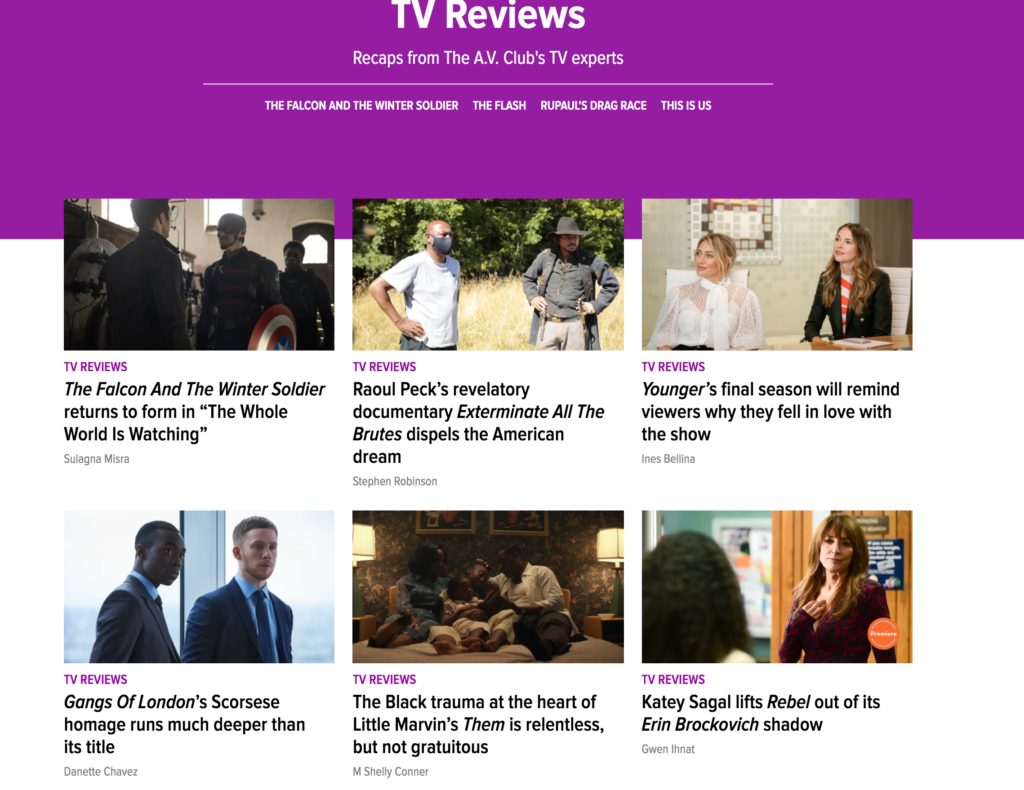
Here’s an example of one online platform for pop cultural criticism, if you want to get a sense of the rhetorical style common to this medium: https://www.avclub.com/

And here, by the way, is how to make a link. Hover over the content you want to link and click the link button shown below:

Categories
How To

Welcome

Welcome to WordPress. If this is your first time making a WordPress site, try checking out Getting Started with WordPress to orient yourself.

To start editing, visit your dashboard. You should have received an email (be sure to check your Spam folder) with your username and a link to set your password.